Thursday, May 18, 2017

Azteca Theater placed on National Register of Historic Places

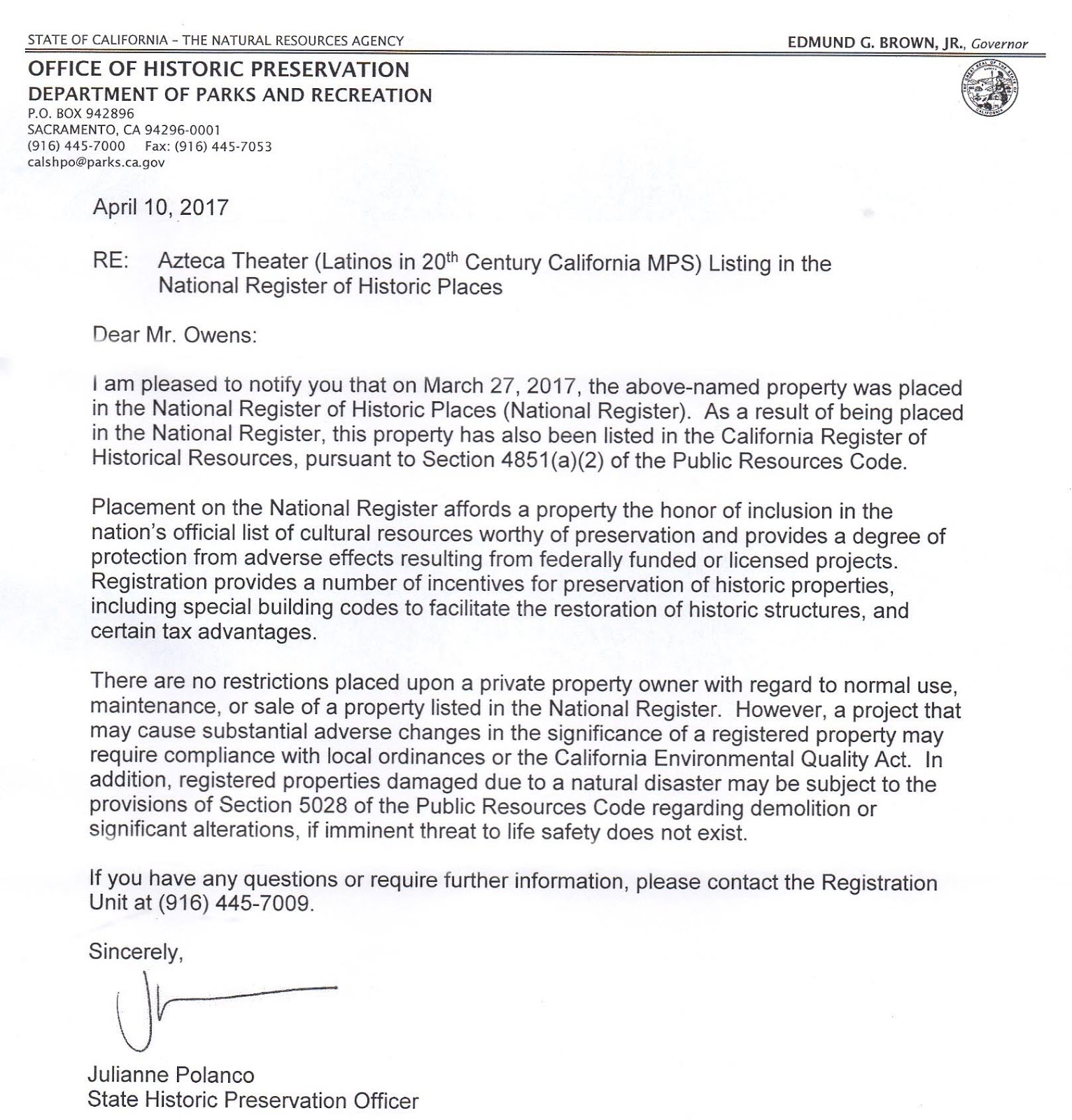
Back in December of 2015 the Fresno City Council passed a  resolution  designating the Azteca Theater a Heritage Property to be placed on the Local Register of Historic Resources. That was the first step of the process for the Azteca to be placed on California's list and be submitted to the National Register of Historic Places.   On March 27, 2017 the Azteca, as it is commonly known,  was put on the Nation Register program for Latinos in the 20th Century.

National Register of Historic Places
The Azteca played a significant role in the develop of Hispanic culture in Central California since it's opening in 1948 by Gustavo Acosta as the main Spanish language theater in the San Joaquin Valley, screening both new releases from Mexican Cinema and musical concerts.

In 1956 the theater blossomed under the leadership of Arturo Tirado, who also hosted tours for famous celebrities and musical groups. 

 In 1961 Tirado held a meeting in San Francisco that resulted in the formation of  the Spanish Pictures Exhibitors Association. Elected President, Tirado represented almost 300 Spanish language movie houses nationwide in negotiations with distributors. 

 In 1965, Cesar Chavez, of United Farm Workers (UFW),  led a strike of California grape pickers on the historic farm workers march from Delano to the California state capitol in Sacramento. Fresno was the largest city on the route as well as the agricultural center of the San Joaquin Valley and proved pivotal to the momentum of the march.

Over 1,000 people gathered at the Azteca Theater in support of the farm workers.  Politicians, middle-class Mexican-Americans and enlightened general population were joining the line.

Tirado retired in the 1980s and the theater suffered lower attendance and eventually closed until 1999 when David Owens acquired it. He opened the iPacific Gallery in the lobby while efforts were being made to get the big hall open. 

On September 26, 2014, the theater re-opened for events in the main hall under the management of Laura Barboza, who continues to make improvements and host a variety of events. The possibilities are just beginning.


Locally, Karana Hattersley-Drayton, of Fresno's Historic Preservation helped prepare the local Historic Fresno designation and worked with National Park Service staff for submission to the National Register.

Considerable research was done over several years  to document significant  historical and cultural events related to Latinos in Twentieth Century California.

Building on it's heritage, the Azteca Theater continues to seek ways to serve the Spanish language, as well as multi-cultural, communities of Central California.

--- David Owens, May 18, 2017

Azteca mural project 2016
Azteca Theater on Facebook

Teatro Azteca on Facebook

Friday, April 8, 2016

More Azteca Theater as photographic model

Here is another image that caught the lens of a photographer. This time, Luis  Sinco collection of outtakes from his photo shoots.

The exterior of the Azteca Theater in the historic Chinatown district of downtown Fresno.
The Los Angeles Times called it the "defunct" Azteca Theater, which was not really accurate.  At this time the lobby of Azteca Theater was home to the iPacific Gallery  while preparations were being made to open the main auditorium.

In this view of the ticket booth has several interesting features.  I replaced the ticket booth glass with plexiglass and made a communication opening with the grill form a computer fan.  The American flag covers an ugly grill that made the door window secure.  The closed sign indicates the gallery was closed. It was open weekends and on Art Hops.  The original round windows in the theater doors were enhanced with auspicious Chinese symbols etched into the glass. 


PHOTOGRAPH BY: Luis Sinco / Los Angeles Times

"Outtakes | Luis Sinco
A photographer may take dozens of shots for an assignment, and they’re usually edited down to just a few images for use in the newspaper and online. Details and moments significant to the photographer often don’t make the cut. Outtakes presents a selection of those images."
See more of Sinco's images at
http://framework.latimes.com/2014/04/03/outtakes-luis-sinco-10/#/11


See more artistic takes on the Azteca Theater here:
http://aztecatheater.blogspot.com/2011/06/azteca-theater-as-photographers-model.htmlhttp://aztecatheater.blogspot.com/2011/06/azteca-theater-as-photographers-model.html

Friday, December 4, 2015

Council names Azteca Theater an Historic Property

The Fresno City Council passed a  resolution Thursday, December 3, 2015 designating the Azteca Theater a Heritage Property to be placed on the Local Register of Historic Resources. 
First stop on the Biking Through History event, October, 2015
This culminates several months of process that started with the Historic Preservation Commission for the Azteca Theater, as well as six other Fresno properties designated by the council.

Other properties designated were the Dudley and Elsie Bates Home 718 E. Carmen Ave, the Judy Tobacco Building 155 Van Ness Ave., the Squirt Bottling Company Building 152 M Street, the Alice and John Williams Home 1525 N. Wishon Ave., United Grocers Inc. Wholesale Grocery Building 414 P Street, and the White Truck Company/Electric Motor Shop at 253 Fulton Street.

These properties will be added to the existing Fresno Register of Historic Resources http://historicfresno.org/lrhr/index.htm


The report to the Historic Preservation Commission:


Wednesday, December 2, 2015

Cesar Chavez, the Delano-to-Sacramento marchers at the Azteca Theater

A major rallying point for the Delano-to-Sacramento march was Fresno and the Azteca Theater. With Eight days and 100 miles behind them, the marchers from Delano made it to Fresno.
Delano-to-Sacramento marchers. Photo Jon Lewis, March 1966
For six months they had discussed the Plan of Delano and fought to gain collective bargaining rights.
Cesar Chavez spoke to over 1,000 people at the Azteca Theater March 24, 1966.
A small ad in the The Fresno Bee March 23, 1966  invited people to come to see Chavez speak.
Fresno Bee, March 23, 1966

Over 1,000 people showed up to listen and show support, at the rally with Cesar Chavez at the Azteca Theater, many spilling out on to F Street. The headline in the Bee highlights a meeting of Mayor Hyde with marchers. 
Fresno Bee, March 25, 1966

Fresno Bee, March 14, 1966
A photo taken March 24 on F street shows the crowd at the Azteca Theater.
Photo from "The Movement" taken outside the Azteca Theater March 24, 1966


Wednesday, March 11, 2015

The humble, but, oh so important, theater urinal

By David Owens
One very important aspect of vintage theaters that is often overlooked is the usefulness of the restrooms.  On a recent tour of the Holly Theatre in Medford, Oregon, under restoration,  this became shockingly clear.

As I descended the steps to the Men's Room I was greeted with a confusing view that took a moment to comprehend.  A porcelain buttress protruded into the room that was vaguely familiar, yet foreign. 

A two-sided urinal at the 1930 Holly Theatre
There was a urinal facing me, but wait, it is not flush to the wall, it is at an angle. And just around the 4' privacy buttress there is a second urinal. But just one drain and one flush pipe.

Wow, those 1930 geniuses of space saving design, two urinals in the space of one!  I am surprised I have not seen something similar at IKEA for small spaces! 

Upon reflection, this is a novelty that works best when the room is not crowded.  First, you have to make a choice - Do I take the left stall or the right stall?  The left faces the entrance so I can greet incoming guests, the right faces the wall so they surprise me from behind.  Neither option makes me particularly comfortable.

This brings a new understanding of the term "pissing contest."  If two men enter at the same time they can face off and have a rousing critique of the movie they are watching. Or perhaps, check-to-cheek they will experience an uncomfortable bladder lock and it truly is a contest to see who can concentrate and finish first!

Maybe this worked well in 1930, but since I have only seen one other example of this anywhere, perhaps not.  The fix is simple, put a privacy shield on top of the urinal perpendicular to the wall that avoids that awkward eye contact during personal business.

Others have tried to save space at the men's room, and it is not easy to redefine personal space. This placement is just too cozy.

Lest anyone wonder, the men's urinals at the 1946 Azteca Theater  are separate and customers face the wall.  Boring as it may be, given the alternatives, we are grateful.


Azteca Theater men's urinals- thankfully boring.

But let's not write of the novelty urinal of 1930.  In forward-looking and progressive Amsterdam they are not to be outdone.  Why stop at double urinals when you can have four-sided urinals. And why put them in a room when it is so much more liberating to do your business in public? 

We have all seen uncouth persons relieving themselves conspicuously on city streets. Why not turn this into a cool happening that all will want to participate in?

Public urinals in Amsterdam

But the best solution of all to avoid the awkward silence staring at the wall over the urinal is to face off with a pleasant stranger who neither looks down or tries to make nerrvous conversation.

Wait a minute, these figures are watching!  Well, perhaps with a sense of humor there will be no more nervousness and men can happily  go with the flow.

Urinals at an Australian rail station.


Wednesday, October 1, 2014

Cesar Chavez, the Azteca Theater, and the march to Sacramento

The Azteca Theater in 1965 as Cesar Chavez and the Delano marchers reach Fresno enroute to Sacramento. Photo by Gerhard Gscheidle, for The Movement, April, 1966.

By David Owens

The story of Cesar Chavez and the United Farm Workers (UFW) is well known, especially in California. What is less known is the role of the Azteca Theater in that famous march to Sacramento.

It started in 1962, when Chavez co-founded the National Farm Workers Association (NFWA) with Dolores Huerta. It was later called the United Farm Workers (UFW).

In 1965, Chavez  led a strike of California grape pickers on the historic farm workers march from Delano to the California state capitol in Sacramento. Fresno was the largest city on the route as well as the agricultural center of the San Joaquin Valley and proved pivotal to the momentum of the march.

The UFW asked all Americans to boycott table grapes to show support for farm workers. The strike lasted for five years and encouraged many improvements for farm workers.


When the march reached the Azteca Theater it gained critical mass. Over 1,000 people gathered around the theater in support  Politicians, middle-class Mexican-Americans and enlightened general population were joining the line. The Movement, April 1966. Photo by Gerhard Gscheidle.
When the Mayor of Fresno learned of the march heading to Sacramento through Fresno he was concerned on how to avoid a potentially volatile situation.  He contacted Police Chief Hank Morton who in turn called upon Arturo Tirado, of the Azteca Theater, to help make sure there were no problems for the marchers or local residents. 

Tirado was well-known in the state and his theater had become the center of Hispanic culture in the San Joaquin Valley.  With his help, the route through Fresno was arranged and his guidance helped keep the peace. The Azteca Theater on F Street -- with it's 760 seats and location just off the main highway -- made it a good gathering point.

Fresno was the largest city on the route to Sacramento. When the march reached the Azteca Theater it gained critical mass. Over 1,000 people gathered at the theater in support of the farm workers.  Politicians, middle-class Mexican-Americans and enlightened general population were joining the line.

Over the ensuing years Cesar Chavez stopped at the theater several times, including a visit with presidential hopeful Bobby Kennedy.
In addition to running the Azteca Theater, Arturo Tirado was well-known for bringing the most famous stars and musicians from Mexico to California, often hosting them for their tours. And on occasion, served as a liaison between the Mexican-American population and local government.
 
Sources:
Oral history from Dick Avakian, 1915-2009, known as the unofficial mayor of Fresno's Chinatown, holding court at Dick's Menswear for over 60 years. http://aztecatheater.blogspot.com/2010/06/remembering-chinatown-treasure.html

The Movement, April, 1966. Published in San Francisco.

California History Magazine Volume 83, No. 4
Arturo R. Tirado and the Teatro Azteca: Mexican Popular Culture in the Central San Joaquin Valley, by Manuel G. Gonzales 83-46


L.A. Times, Mark Arax, Standing Tall in Fresno, a short background in Fresno's wild and wooly days.  A colorful synopsis of the Fresno Police and the events that lead to California's Three Strikes law. http://articles.latimes.com/1992-12-06/news/mn-3568_1_fresno-police-chiefs

Photographer Gerhard Gscheidle came to San Francisco in 1964 and became a photographer there and in NYC before returning to Germany.

http://www.gg-photo.de/

For events and activities at the Azteca Theater
https://www.facebook.com/AztecaTheater
For Spanish language centered events and activities at Teatro Azteca:
https://www.facebook.com/profile.php?id=100007752855814


Monday, September 22, 2014

Grand Re-Opening Celebration


The Azteca Theater is holding a Grand Re-opening event on Friday, September 26, 2014, 6:00 -9:00 p.m.
The current effort to save the theater began back in 1999, but it has been Laura Barboza and her supporters working on the space for the past year who are making this happen. The first grand opening was in 1948, a mere 66 years ago. For the many who have asked for a peek inside, this is your chance!
Teatro Azteca Grand Re-opening event on Facebook

 Check your Calendar!


Besides getting a look at the theater and meeting the people who are involved there will be several performances. A Bi-lingual friendly event.
     -  Los 3 Ambrios (English language)
     -  Dance performance by Caris and Company
     -  Bachata singers You're It from San Franciso,
     -  Singer Irma Trujillo

     -  Caricatures by S.W. Parra
     -  A mini video clip of a man telling some old stories from when the 
       theater was open. Also a little bit of the history and the future plans.
     - Expresiones Teatro. Is doing a drama show
     - Art exhibit by local painters

And more! 


Come share a happy milestone in the history of the Teatro Azteca.  Event is free, but donations will be accepted if you wish. Want to get involved? There is more to be done!

Monday, February 17, 2014

Classic Cantinflas 'El Circo' at the Azteca Theater

Mario Morena "Cantinflas" in El Circo 1943
Azteca Advertisement

Classic comedy El Circo showing at the Azteca Theater!

Welcome to the Teatro Azteca in 1970 for a showing of the 1943 B&W classic El Circo!

Cantinflas (Mario Moreno) is a cobbler who gets a job in the Circus as a janitor, recommended by a beautiful girl circus performer.


El Circo poster, 1943


Soon, Cantinflas gets in trouble when he participates  in dangerous acts, such as the flying trapeze!


Clearly, our friend will risk his life for the love of his new girlfriend!


Cantinflas masters the trapeze as only he can!
Watch it now!


This 1943 version with Moreno is a version related to Chaplin's The Circus (1928)

Mario Fortino Alfonso Moreno Reyes, known as Mario Moreno, (August 12, 1911 – April 20, 1993) was a Mexican comic film actor, producer, and screenwriter known professionally as Cantinflas. He often portrayed impoverished campesinos or a peasant of pelado origin.


Cantinflas - El circo


The character came to be associated with the national identity of Mexico, and allowed Cantinflas to establish a long, successful film career that included a foray into Hollywood.
Charlie Chaplin once commented that he was the best comedian alive, and Moreno has been referred to as the "Charlie Chaplin of Mexico."
El Circo title

El Circo, 1943, Posa Films
Director Miguel M. Delgado
Música Manuel Esperón
Fotografía Gabriel Figueroa (B&W)
Reparto
Mario Moreno "Cantinflas" (el zapatero), Gloria Lynch (Rosalinda), Estanislao Schillinsky (Shilinsky), Eduardo Arozamena (don Martín), Ángel T. Sala (el Coronel Buitrago), Rafael Burglete (bailarín), Tito Novaro el doctor Tanner), Leonid Kinskey (un agitador).

Monday, May 27, 2013

A look at Azteca Games

Exotic Aztec flavor adds adventure to game spinning

Always interested in things Azteca, I wondered how video games are influenced by the Aztecs. Not surprisingly, the Aztec Mystique is alive and well for video gaming.  These Aztec games will not be part of the Azteca Theater offerings. However, I hope you find them amusing.   I especially enjoyed the graphics for the first game which reminded me of Tomb Raider and the Aztec background music from the second.

Hunting for lost Azteca treasure is an adventurous theme inspiring a number of video slot  games. Giant temples, sacrificial rites, Aztec Kings, beautiful Aztec women, headdresses, masks and gold treasure add excitement from the Empire of the Aztecs.

People wager real money at casinos on these games in hopes that the Aztec gods will smile fortune upon them. However, no need to wager money to try them. Two of these games can be played for free online.

1. Azteca - The latest Aztec-inspired game
Azteca video game

Lara Croft, Tomb Raider
The video slot game Azteca  was introduced last year by Playtech. The look of Azteca reminds me of Lara Croft and Tomb  Raider.  The heroine is a very attractive figure that could just as well  be Angelina Jolie / Lara Croft.

As you can see from the three games listed here, the graphics have been improving, with Azteca being the most recent and most attractive.

This game is not available online in the USA as people are not allowed to play, even for free,  online gambling games that are offered in a casino in the USA. 


Azteca Sun Temple
Azteca gods


2. Aztec Treasures - Five reel video slot game
Aztec Treasures introductory screen
Aztec inspired background music with drums and flutes that makes you want to start dancing adds interest to this game.  The real icons are jewels, portraits and gold.  Like most video slot formats, there are five reels and 20 lines to win.

Each winning spin is rewarded with a little animation from one of the winning squares for a touch of fun and advancement from the traditional mechanical slot machine games.

Play Aztec Treasures online here for free
http://www.thevideoslots.com/free-video-slots/free-aztec-treasures-bs-video-slot.html
Play Aztec Treasures online for free, smaller screen
http://vegas-slots.com/aztec-treasure.html

3. Aztec's Treasure - Old School five reel video slot game


Aztec's Treasure Slots,  by Real Time Gaming (RTG), acts much like a traditional slot machine, you can hear the wheels spin and related sound effects  as colorful images whiz by.

Play Aztec's Treasure here for free online
http://www.thevideoslots.com/free-video-slots/free-aztecs-treasure-rtg-video-slot.html

I hope you enjoyed this roundup of Azteca games.
- David Owens

Thursday, May 23, 2013

Alien Abduction Fantastic Idea for Chinatown

The Azteca ticket booth last night.

Where in the world is 
Maria of Chinatown?  
Could she be out of this world?  

Recent events in Fresno's Chinatown suggest there may be unforeseen forces at work. 
Story and photographs by David Owens
Original story: Who kidnapped Maria of Chinatown?

 A few years back the underground tunnel publicity in Chinatown revealed a mysterious history under our feet.  Silent ghosts, buried secrets, passages to nowhere, murder,  and forgotten lives fuel our imagination. But this is Chinatown's past and the tales we can imagine are far more exciting than the facts known.

Every night the streets of Chinatown bring their own plots and subjects for the imagination.  People appear out of nowhere, some on a mission, some wandering about in odd ways changing direction and speeds in rhythms only they can understand.  Behind these characters that grab our attention, the local residents go about their business, meeting someone, going down to the store for groceries, getting a burrito at Chris's Meats.

On weekends a taco stand sets up in front of the Azteca and smiles and laughter are heard as people eat and chat. Cars bring customers to La Fiesta the Spanish music night club next door.  Still more cars bring people down F Street to the Full Circle Brewery for some of the most interesting live music and events in Fresno. 

Personal encounters

A shadowy figure with slender limbs and large
head lurking in doorways on F Street.Alien? Nah, could it be?
Seen here at Salaam Seafoods, a great
restaurant during the day.
Indeed, F Street is never dull.  As the night wears on you notice groups of drifters, mostly from the homeless community the other side of Ventura Street.  The Fresno Rescue Mission and Poverello House serve a large community South of the center of Chinatown.  On the fringe are people with addictions and mental illnesses who have no where else to go. At first glance they can be scary to the uninitiated.

However, after more than a dozen years on the nighttime streets of Chinatown I feel safer here in the Tower District.   Less theft and less violent crime in Chinatown. I am safe here.  Aware of my surroundings and safe.   None of these street people have guns.  If they did they would have sold it for a beer or illegal substances they crave.  The worst problem, though minor, is an insistent panhandler.  "You gotta dime? Got a smoke?  A sincere no usually sends them away. Often the only word heard is 'Hey," the rest is communicated with gestures and body language.

For the person prone to a medical emergency, Chinatown is the place to have it. The response from Fresno Fire Station #3 at Fresno and E Streets is phenomenally fast.  Fire suppression? No problem.  The Fresno Police Department does well, but since they have not been able to have the dedicated neighborhood patrols as they did some years ago, they are not able to do as much proactive work as before.

Aliens of all kinds

Last night at the Azteca ticket booth a ghostly green light appeared in the shape of an alien. At first appearing to be menacing, soon I understood the expression  was simply tranquil, eyes probably closed and observing F Street through other senses. Hey, maybe...
838 F Street
Another guardian spirit has come in Maria's absence.  No longer will people stop, cross themselves and say prayers. Now the reaction is more a furtive glance and a quickened pace.  No more lingering for now.

K-Jewel music floats under the marquee, Cranberries, Avril Lavigne ...  a change! Music from foreigners...aliens!  Under Maria's reign as patron saint of F Street K-Jewel was a Sinatra station, the real classics of the American songbook.  Change is a certainty, even in historical Chinatown.

Before the railroad came to begin the future Fresno on the sinks of Dry Creek there were Chinese citizens living in wood houses and building underground basements and tunnels. They came originally for the gold rush and stayed. They were non-citizens ... again aliens!  The aliens occupied Fresno before there was a Fresno.

Each wave of immigrants that came to new agricultural hub called Fresno started in Chinatown, The West Side, or the wrong side of the tracks.  The Italians, the Armenians, the Mexicans, the Japanese, the Volga Russians and the rest.  The aliens came to Chinatown to get a start a new life in America, to become un-alienated.

Suddenly, people walk down the middlle of the street, a car appears.
The night brings this history to life. Darkness hides the dust, dirt and neglect. The bones of old buildings stand strong and imagination draws the missing pieces.  And the lost people of Fresno come into their own.  No longer suppressed by the watchful daytime people, they are here in force.   Relaxed and empowered.  No pretensions.

There are still some hard working people looking for their way up the ladder of success. Some are undocumented aliens from Cuba, Mexico and South Americas still looking for their place.  But there are also many who will never find the first rung.

Let's "Keep Chinatown Different"

Chinatown is the one area of town where the unexpected happens daily.  If aliens live among us, they started in Chinatown.  Anything can happen.  A manikin can be named Maria and become a saint.  And disappear in a mysterious abduction. Alien abduction? Too soon to tell.

Serious UFO hunters say Fresno lies at the bottom of the "Nevada Triangle" that includes Area-51 and China Lake. The other areas have military aircraft  activity that can spark unexplained observations. However, Fresno does not. Could the Chinese tunnels connect to alien portals? Are the Chinatown night behaviors  caused by alien experiments? Can we conjecture that Chinatown disappearances are alien abductions? 

 Questions about aliens and UFOs in the Fresno area are not new. 
Celestia, aka Anne Heche
Sightings and speculation increased dramatically in 2000 when Anne Heche was spotted partially clothed knocking on doors in Fresno looking for a space portal while possessed by an alien she called "Celestia."  For many, this was the first time the possibility of alien contact in the San Joaquin Valley had been considered.


Under the marquee at the Azteca Theater
Ooooh! As Anne Heche, speaking as Celestia, said, "Ik all notra daska don!"  "It's too scary for me now." 

In all seriousness, Chinatown is where unusual things do happen in Fresno.  Where Maria the Manikin went is open to speculation and over-active imaginations. Maybe she will return and add another chapter to her story. For now, I'm glad Chinatown is different.

Keep Chinatown Different. A new mantra.

Wednesday, May 15, 2013

Who kidnapped Maria of Chinatown?

For the past twelve years Maria presided over the ticket booth at the Azteca Theater. Countless passersby stopped to greet her and for
Maria of  Chinatown
many she took on religious significance as they stopped, crossed themselves, and spoke prayers and blessings.  She was a vision of grace, beauty and hope.

Maria began her life in Chinatown as a clothing display specialist at Mary's Liquor on F Street 50 years ago.  Mary ran the store to serve residents of Chinatown and stocked more that the usual convenience store including some clothing. And Maria sported the best clothes and was quite popular with her good looks and slim 1960s figure.

ArtHop Chinatown
When the store was closed twelve years ago I asked what would happen to Maria who was already named for her  well known innocent and kindly looks reminding some of the Virgin Mary.

Soon Maria came to work for  the Azteca Theater.


Mardi Gras Chinatown
Maria cast her gaze across the sidewalk and  F street 24 hours a day. She welcomed visitors for ArtHop and Chinatown events keeping a positive outlook.

Sometimes she would get dressed up for holidays such as Christmas and the Fourth of July.  She gained some beaded necklaces for Mardi Gras and a Chinese hat for the Chinese New Year parade.
Maria in her Christmas hat

She kept a light burning around the clock and cast a kind look towards all. Some locals began to stop in front of her to say a prayer and pay their respects. She never looked disapprovingly or was unwelcoming.  She blessed many who had few blessings.

Maria Fourth of July
Hers was not always an easy life.  She observed her share of erratic behavior by those wandering the streets on the edge of normalcy.  People who were homeless, addicted or suffering mental confusion.  In 2008 she was assaullted for the first time. A confused individual broke through the security bars and tossed a heavy planter towards her before raising a misguided hand towards her and tore her brown hair off and escaped down the street. 

Shaved head for solidarity
Maria did not hold a grudge. For awhile she wore her bald head proudly in support of cancer survivors she had seen over the years.  Eventually she decided to change her look and become a redhead.  Never one to dwell on life challenges, she bravely carried on.

In the early hours of May 14, 2013 Maria was kidnapped. Security bars were forced open, the booth broken into, and Maria was taken.  And although she will remain brave and resolute through this adversity, she most certainly would rather be back at the Azteca Theater greeting her friends and those in need.

Maria in recent times in her auburn look.

No ransom note has been received and no one has taken credit for the abduction. The motive remains elusive.  We only can solace in the fact that wherever she is she will be doing her work to soothe the savage soul and bring blessings to those who are deserving.

Ever since Maria started her watch on F Street she has been adored and studied.  Many photographers have chosen her for their subject.  Azteca Theater as photographers model